Automated Solar Panel Cleaning Robot
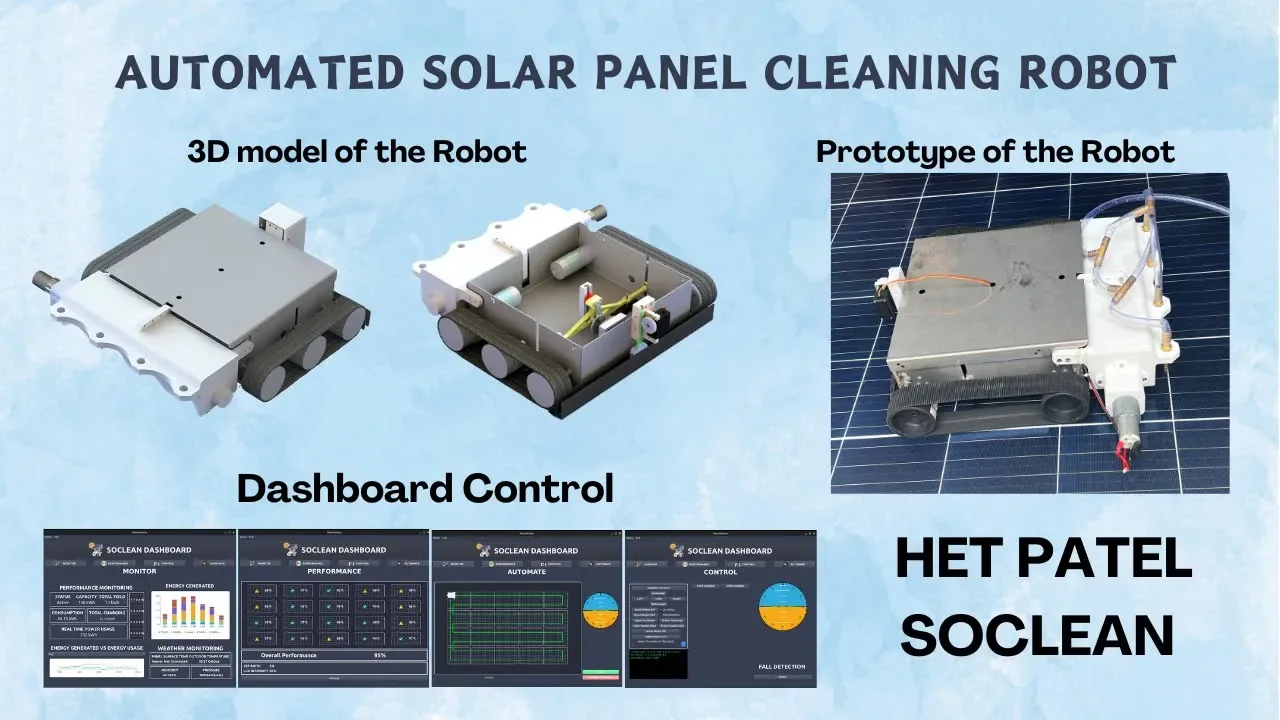
Built an ESP32-controlled solar-panel cleaning prototype with tracked drive, roller brush, water delivery, a servo brake, and a Qt6 dashboard. The report documents mechanical fabrication, wireless actuator control, and prototype trials.
Technical work
VIT capstone · Fabricated and tested prototype
- Built an ESP32-controlled cleaning prototype combining tracked drive, a roller brush, four-nozzle water delivery, a servo brake, and a rack-and-pinion wiper.
- Developed a Qt6 dashboard for UDP control of drive and cleaning actuators, Firebase REST sensor monitoring, and route definition for planned cleaning patterns.
- Designed stainless-steel chassis and cleaning assemblies for CNC cutting, bending, TIG welding, and printed parts; documented prototype trials on solar panels.
- Sized a 4,200 mAh battery against an estimated 16 A actuator load, calculating approximately 10–13 minutes of operation after allowances for losses.
Team & Context
Author: Het Patel (20BEC1165)
Advisor: Dr. Sheena Christabel Pravin, Assistant Professor Senior Grade
Institution: School of Electronics Engineering, Vellore Institute of Technology, Chennai
Date: April 2024
Overview
This capstone combines a stainless-steel tracked chassis, roller brush, four-nozzle pump system, and rack-and-pinion wiper with an ESP32 controller and Qt6 dashboard.
The report describes the prototype as manually operated. The dashboard also includes route-definition functionality for proposed automation; autonomous route execution remains further work.
Problem Statement
Dust accumulation reduces solar-panel output. The design explores a repeatable cleaning mechanism that can be remotely controlled while limiting manual work on the panel surface.
- Manual cleaning requires access, labor, and a repeatable maintenance schedule.
- Water delivery must cover the brush path without unnecessary overspray.
- Contact pressure, traction, and cleaning materials must be compatible with the panel surface.
- A practical automated system also needs edge detection, verified stopping behavior, and tests across panel inclinations.
Key Features
Hardware Design
- Robust Chassis: Stainless steel 304 Grade (1mm sheet) with CNC laser cutting, CNC bending, and TIG welding
- Caterpillar Track Drive: Four 12V geared DC motors (50 RPM, 346.8 N-cm torque) with 40mm width track belts
- Active Cleaning Mechanism: Roller brush assembly with 12V DC motor (100 RPM, 103 N-cm torque)
- Water Delivery System: Centrifugal pump specified at 8 W and 10 L/min, distributing water across four nozzles; the report includes a calculated flow-velocity estimate
- Automated Wiper: Rack-and-pinion mechanism with servo motor for surface drying
- Braking System: Linear slider-crank mechanism with servo control, designed to support positioning on inclined panels
Software & Control
- Qt6 Cross-Platform Dashboard: Runs on Windows, macOS, and Linux with rich GUI
- UDP Communication: Wireless drive and actuator commands between the Qt dashboard and ESP32
- Performance Analytics: Individual panel visualization with color-coded indicators
- Route Definition: Dashboard interface for predefined cleaning routes and serpentine patterns; autonomous execution is an extension
- Firebase Integration: REST API for live sensor data streaming and cloud monitoring
Technologies Used
Hardware
Software
Manufacturing
Prototype Results & Design Calculations
- Prototype: Fabricated chassis, cleaning assembly, actuation, and dashboard demonstrated in the project report and video.
- Battery estimate: A 4,200 mAh battery and approximately 16 A actuator-load estimate give about 10–13 minutes after allowances for losses; this is a sizing calculation.
- Water distribution: Nominal 10 L/min pump capacity split across four outlets, equivalent to 2.5 L/min per nozzle before hydraulic losses.
- Brush specification: 100 RPM motor rated at 103 N-cm; these are design component specifications.
- Evaluation scope: The report does not establish measured water savings, annual energy-yield improvement, packet-delivery statistics, or a quantified incline-performance envelope.
Challenges & Solutions
Traction on Inclined Panels
Problem: Standard wheels slip on smooth, tilted solar panel surfaces.
Solution: Caterpillar track belt system with soft rubber compound and idler pulleys for tension maintenance.
Uniform Water Distribution
Problem: Single-point water delivery creates uneven coverage and wastes water.
Solution: Four-nozzle distribution system with calculated flow rates spread along the cleaning path.
Real-Time Communication
Problem: Wireless control can experience packet loss and delays.
Solution: UDP connects the dashboard to the ESP32. Communication-loss stopping, acknowledgments, and retry behavior need explicit testing before autonomous operation.
Future Work
- AI Integration: Machine learning for predictive cleaning schedule optimization
- Computer Vision: Camera-based dirt detection for targeted cleaning verification
- Solar-Powered Operation: Self-charging capability for extended autonomous operation
- Multi-Robot Coordination: Fleet management for large-scale solar farm deployments
- Weather Integration: Automatic scheduling based on weather API forecasts